
Sustainable Innovation in Pharma: Green Synthesis Process for Lenalidomide API
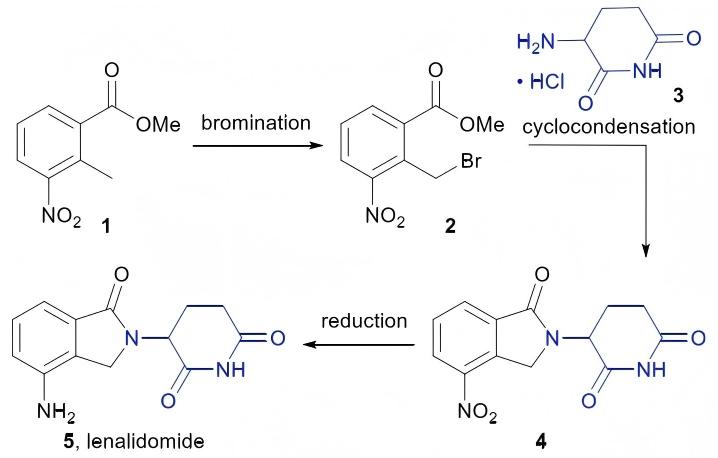
A major breakthrough has recently been achieved in the research of green synthesis process improvement for lenalidomide active pharmaceutical ingredient. This process perfectly integrates environmental friendliness and production efficiency, effectively solving the environmental problems and cost pain points in traditional production routes, and providing an important practical example for the green transformation of the pharmaceutical industry. The relevant research results have been published in "Org. Process Res. Dev."
Lenalidomide (trade name Revlimid), developed by Celgene, was approved by the US FDA in 2005, initially for the treatment of myelodysplastic syndromes. With its unique immunomodulatory, anti-angiogenic, and antitumor properties, it has become a core drug for the treatment of multiple myeloma and dependent anemia. The successful launch of the first generic version in 2022 further expanded its clinical accessibility.
However, traditional synthetic routes have long suffered from significant drawbacks: reliance on environmentally harmful solvents and expensive reagents or catalysts. In particular, the crucial Wohl-Ziegler bromination reaction requires halogenated solvents and lacks selectivity for benzyl bromination, easily generating dibromination or electrophilic bromination byproducts, causing environmental pollution and affecting product yield and purity. To overcome this industry challenge, the research team, through in-depth research, constructed a three-step green synthetic process, achieving multiple breakthroughs in key reaction steps.
I. Green Optimization of Bromination Reaction
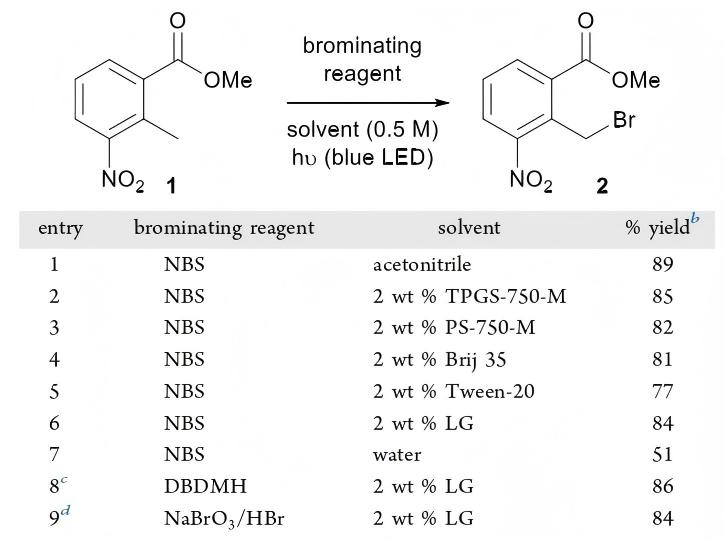
The team innovatively employed lauryl glucoside (LG) as a biodegradable surfactant, successfully achieving the Wohl-Ziegler bromination reaction in an aqueous phase. Experimental data show that in an aqueous system with 2 wt% LG, the yield reaches 84% when using NBS as the brominating agent, and further increases to 86% when using DBDMH as the brominating agent, only slightly lower than the 89% yield of the traditional acetonitrile solvent system. This approach not only avoids the environmental hazards of halogenated solvents but also solves the biodegradability problem of polyethylene glycol-modified surfactants, achieving a green transformation of the reaction system.
II. Breakthrough in Cyclocondensation Reaction
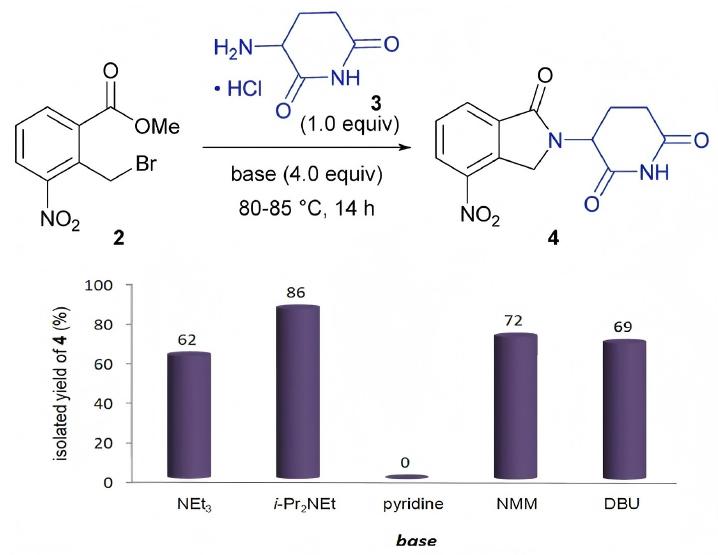
In the cyclocondensation reaction stage, the research team discovered that Hünig's base (i-Pr₂NEt) can simultaneously act as both a base and a solvent, achieving a high yield of 86% without the addition of any surfactant. More importantly, the reaction product does not require complex column chromatography purification; simple filtration and cold ethanol washing yield a product with a purity exceeding 95%, significantly simplifying the production process and reducing industrial production costs. Comparative experiments show that Hünig's base significantly outperforms traditional base reagents such as triethylamine and pyridine.
III. Metal-Free Nitro Reduction
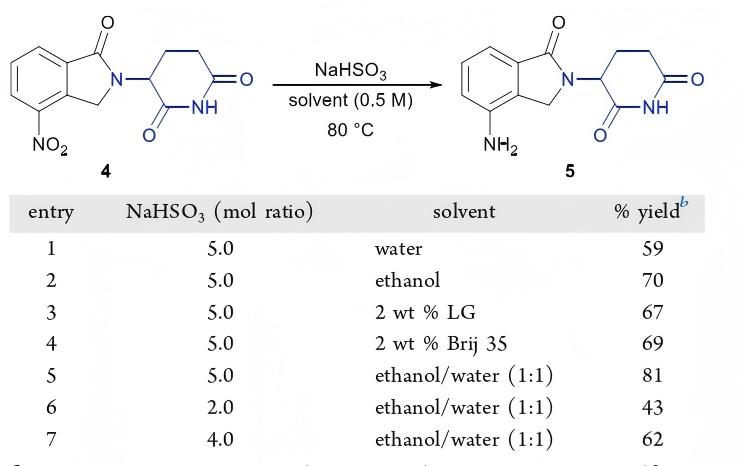
To address the metal contamination problem caused by the use of palladium-on-carbon catalysts in traditional processes, the team developed a metal-free reduction system using sodium sulfite as a reducing agent. In an ethanol-water (1:1) mixed solvent, when the molar ratio of sodium sulfite was 5.0, the reaction yield reached 81%, successfully avoiding the coordination of nitrogen atoms in the lenalidomide molecule with transition metals, thus eliminating the risk of metal contamination in the final drug substance from the source. Experiments also showed that this reduction system exhibited good adaptability in different solvents.
Notably, this green synthesis process demonstrated excellent scalability in gram-scale experiments, achieving an overall yield of 62%. The entire process avoids column chromatography and the use of harmful organic solvents, offering significant advantages such as simplicity, high safety, and environmental friendliness, fully aligning with the green development principles of modern pharmaceutical industry.
Industry experts stated that this research not only provides a practical technical solution for the large-scale green production of lenalidomide active pharmaceutical ingredient (API), reducing the environmental footprint and cost barriers of drug production, but also offers important insights for the green transformation of the global pharmaceutical industry, driving the upgrading of more API production processes towards environmentally friendly, efficient, and sustainable directions.
Read More: Org. Process Res. Dev. 2025, 29, 2984-2988