
Beyond the "Miracle Ingredient": A Modular Formulation Strategy for Hair Loss
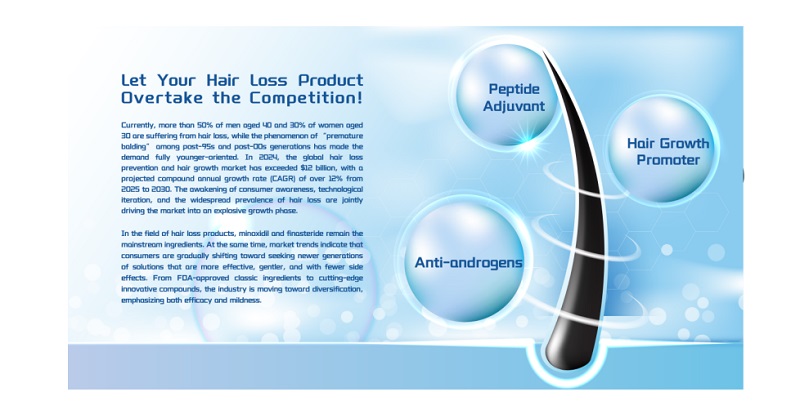
When tackling hair loss formulation, a systematic approach consistently outperforms the search for a single “miracle ingredient.” As a formulator focused on synergy, working on active ingredient and delivery system development at PHMO, I believe effective products are built on functional modules, not isolated actives. Here’s a practical two-module framework: “Nutrient Supply + Antioxidant Defense” and “Anti-DHT + Anti-Fibrosis.”
First, map the two core pathways:
Ⅰ. Microcirculation failure & oxidative stress – poor blood flow starves follicles, while ROS buildup pushes them into the resting phase prematurely.
Ⅱ. Androgen-driven inflammation & fibrosis – DHT overstimulation triggers TGF-β-mediated collagen deposition, gradually shrinking follicles.
Module 1: Nutrient Supply + Antioxidant Defense
- Goal: Restore blood flow and neutralize oxidative damage.
- Synergy logic: Pair a mild potassium channel opener like PYRROLIDINYL DIAMINOPYRIMIDINE OXIDE (boosts local circulation) with Oxothiazolidinecarboxylic Acid (OTZ) (elevates intracellular glutathione). Together, they don’t just deliver nutrients—they protect follicles during delivery. Our tests show this combo increases follicle viability by >3× vs. individual components.
- Formulation note: In serums, add penetration enhancers. In foams/shampoos, consider film-forming polymers for longer residence.
Module 2: Anti-DHT + Anti-Fibrosis
- Goal: Block androgen signaling and reverse perifollicular fibrosis.
- Synergy logic: Use a topical anti-androgen (e.g., RU-58841 or Clascoterone) to competitively block receptors, then add copper peptides (AHK-Cu/GHK-Cu) to stimulate healthy collagen remodeling—completing the loop from signal inhibition to structural repair.
- Formulation note: Leave-on formats (serums, lotions) are ideal. Lipid-based carriers enhance penetration.
From Modules to System: A 4-Step Workflow
Ⅰ. Diagnose: Identify the primary driver—microcirculatory, androgenetic, or mixed.
Ⅱ. Ratio: For early androgenetic alopecia, emphasize Module 2 (~70%). For stress-/age-related thinning, start with Module 1 (60-70%).
Ⅲ. Validate early: Test module combinations (not just single actives) in ex vivo follicle models for viability and collagen metabolism.
Ⅳ. Adapt dosage form: Serums allow deep, controlled delivery; foams/gels prioritize user experience and fast absorption.
Do you lean toward “high-dose star actives” or “multi-target modules” in your development? Share your perspective below.