
Why Peptides Often“Fail”? Delivery Formulation is Key
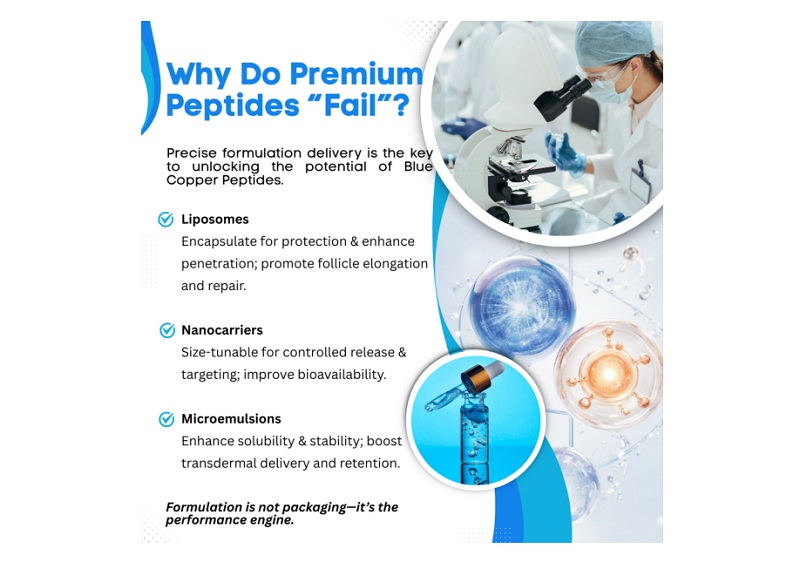
Even the most potent signaling molecule fails if it cannot reach its target. As the industry's leading expert in precise peptide delivery, PHMO systematically breaks down how to build a direct “formulation bridge” to the hair follicle for star ingredients like Blue Copper Peptides (e.g., AHK-Cu / GHK-Cu).
Core Challenges: Beyond Stability
Peptide actives face three key barriers in practical applications:
Ⅰ. Chemical Stability – Susceptible to enzymatic degradation, pH shifts, and oxidation in formulations, leading to reduced shelf life and bioactivity.
Ⅱ. Transdermal Barrier – Hydrophilic peptides struggle to penetrate the stratum corneum; topical absorption remains minimal without enhancement.
Ⅲ. Targeted Delivery – Lack of precise follicular targeting increases systemic absorption risk and weakens local effects such as collagen stimulation and antioxidant protection.
Solutions: Building a “Direct Pathway” with Delivery Systems
We turn these challenges into controllable variables through three proven carrier technologies:
👉Liposomes –Phospholipid vesicles encapsulate peptides, protecting stability and enhancing skin penetration via membrane fusion. Suitable for AHK-Cu to promote hair follicle elongation; liposomal GHK-Cu significantly upregulates VEGF and promotes hair regrowth in alopecia models.
👉Nanocarriers (e.g., Polymeric Nanoparticles) – Submicron particles enable controlled release, improve bioavailability, and can be size-tuned for enhanced follicular targeting. Ideal for sustained-release GHK-Cu in repair systems.
👉Microemulsions –Oil-water systems effectively solubilize peptides, significantly boosting transdermal efficiency and formulation stability. Technologies like ionic liquid microemulsions further improve penetration depth and retention of GHK-Cu.
Key Takeaway: Formulation Is Not Packaging – It’s the Performance Engine
The value realization of high-end actives critically depends on delivery system design. The formulator’s role is to translate lab potential into stable, targetable, and compliant product performance through modular carrier selection and dosage-form adaptation. PHMO specializes in turning these advanced delivery technologies into scalable, market-ready solutions for peptide actives.
Which active ingredient’s delivery issue has been the most challenging in your experience? What delivery technology are you leaning toward or have already validated? Share your thoughts below or DM us for PHMO peptide delivery insights.