
Treosulfan
A DNA alkylating agent. It is used as a myeloablative conditioning agent prior to allogeneic hematopoietic stem cell transplantation.
Overview
Treosulfan is a bifunctional alkylating prodrug belonging to the class of DNA alkylating agents. It is converted in vivo to cytotoxic epoxide derivatives that exert myeloablative effects through DNA cross-linking. As an alternative to busulfan, Treosulfan in combination with fludarabine provides a key myeloablative conditioning regimen for hematopoietic stem cell transplantation.
Synonyms: TREOSULPHAN; 1,2,3,4-butanetetrol 1,4-dimethanesulfonate; (2S,3S)-1-O,4-O-Di(methylsulfonyl)-L-threitol; CB-2562; L-Dihydroxy-Busulfan; Leo 40067; NSC 39069; THREOSULFAN; Dihydroxybusulfan; L-threitol-1,4-dimethanesulfonate; Ovastat; NSC-39069; HSDB-6963; CB-40067; CB-2562; CCRIS-2781; treosulfanum; treosulfano
EINECS: 206-081-0
Product Categories: Alcohols; Alkanes; Antineoplastic Agents; GlycolsCytochrome P-450 CYP2C19 Inhibitors; Cytochrome P-450 CYP2C8 Substrates; API
Mol File: 299-75-2.mol
Physicochemical Properties
Melting point: 76-78°C
Storage temp: -20°C
Solubility: Acetone (Slightly), DMSO (Slightly), Methanol (Slightly), Water (Slightly)
Form: Solid
Color: Off-White to Pale Beige
Water Solubility: H2O: 5mg/mL, clear
Stability: Light Sensitive
MSDS Information
Experimental Data
1. Cell Experiment
DMSO : ≥ 100 mg/mL (359.32 mM)
H2O : 50 mg/mL (179.66 mM; Need ultrasonic)
* "≥" means soluble, but saturation unknown.
Need ultrasonic)
Preparing Stock Solutions:
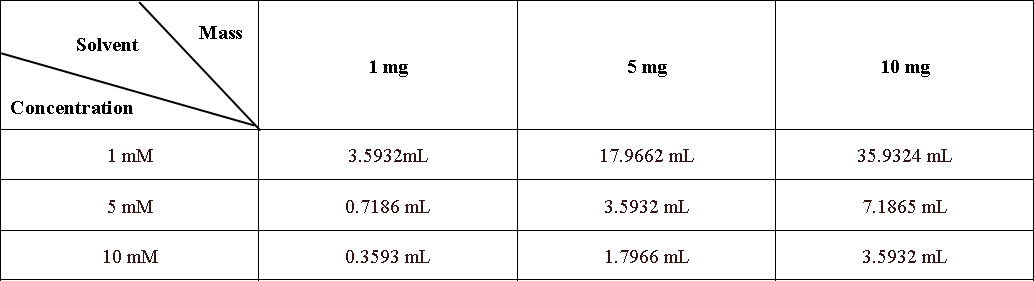
Please select an appropriate solvent for preparing the stock solution based on the product's solubility in different solvents. Once prepared, the solution should be aliquoted and stored to avoid product degradation caused by repeated freeze-thaw cycles.
Storage conditions and duration: -80°C for 6 months; -20°C for 1 month. When stored at -80°C, use within 6 months; when stored at -20°C, use within 1 month.
2. Animal Experiment
Please select an appropriate dissolution protocol based on your experimental animals and route of administration. For the following protocols, first prepare a clear stock solution following the in vitro method, then add cosolvents sequentially:
To ensure experimental reliability, the clear stock solution can be appropriately stored according to storage conditions. For in vivo working solutions, it is recommended to prepare them fresh and use on the same day. The percentage indicated before each solvent represents its volume ratio in the final solution. If precipitation occurs during preparation, heating and/or ultrasonication can be used to aid dissolution.
Protocol 1
Add solvents in order: PBS
Solubility: 16.67 mg/mL (59.90 mM); Clear solution; Ultrasonic treatment required
Protocol 2
Add solvents in order: 10% DMSO → 40% PEG300 → 5% Tween-80 → 45% saline
Solubility: ≥ 2.5 mg/mL (8.98 mM); Clear solution
This protocol yields a clear solution of ≥ 2.5 mg/mL (8.98 mM, saturation unknown).
Example for 1 mL working solution: Add 100 μL of 25.0 mg/mL clear DMSO stock solution to 400 μL PEG300 and mix well. Add 50 μL Tween-80 to the mixture and mix thoroughly. Then add 450 μL saline to bring the volume to 1 mL.
Protocol 3
Add solvents in order: 10% DMSO → 90% (20% SBE-β-CD in saline)
Solubility: ≥ 2.5 mg/mL (8.98 mM); Clear solution
This protocol yields a clear solution of ≥ 2.5 mg/mL (8.98 mM, saturation unknown).
Example for 1 mL working solution: Add 100 μL of 25.0 mg/mL clear DMSO stock solution to 900 μL of 20% SBE-β-CD in saline and mix well.
Protocol 4
Add solvents in order: 10% DMSO → 90% corn oil
Solubility: ≥ 2.5 mg/mL (8.98 mM); Clear solution
This protocol yields a clear solution of ≥ 2.5 mg/mL (8.98 mM, saturation unknown). This method is not suitable for experiments lasting longer than two weeks.
Example for 1 mL working solution: Add 100 μL of 25.0 mg/mL clear DMSO stock solution to 900 μL corn oil and mix well.
Pharmacodynamics
Treosulfan showed hematopoietic stem cell depleting activity as well as immunosuppressive and antitumor activity in mouse models of leukemia. An increase in treosulfan exposure was associated with an increased incidence of infection-related death.
Mechanism Of Action
Treosulfan-specifically its active epoxide metabolites - function as a DNA alkylating agent, which is likely responsible for its cytotoxic activity. DNA alkylation involves the substitution of alkyl groups for hydrogen atoms on DNA, allowing for cross-linking within the DNA molecule resulting in cytotoxic, mutagenic, and carcinogenic effects.
Similar Products

Amifostine
Therapy
: Oncology
Target
: Alkaline phosphatase
CAS
: 20537-88-6
MF
: C5H15N2O3PS
MW
: 214.22

Carboplatin
Therapy
: Oncology
Target
: DNA
CAS
: 41575-94-4
MF
: C6H12N2O4Pt
MW
: 371.25
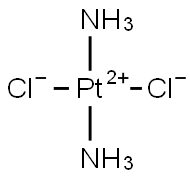
Cisplatin
Therapy
: Oncology
Target
: DNA
CAS
: 15663-27-1
MF
: Cl2H6N2Pt
MW
: 300.04
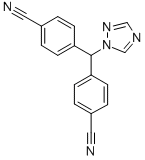
Letrozole
Therapy
: Oncology
Target
: ERs;Aromatase
CAS
: 112809-51-5
MF
: C17H11N5
MW
: 285.3